
Choosing a heavy-duty regulator by port size or the label “single stage” can leave you with pressure drift, seat damage, or an unsafe gas installation. By the end, you will be able to compare single-stage and double-stage designs, define the operating specification, match materials to the gas, and ask a supplier for the performance evidence needed for cylinder, manifold, and process-plant service.
Key takeaways
- Choose single-stage regulation for stable headers and moderate pressure variation.
- Specify inlet, outlet, flow, droop tolerance, connections and temperature limits.
- Match wetted materials and seals to the gas, concentration and contamination risks.
- Request test records, material details, traceability and installation guidance before purchase.
When is a single-stage regulator the right choice?
A single-stage regulator suits a stable plant header or a point-of-use outlet where moderate pressure variation will not disrupt the work. It reduces source pressure in one step, with lower installation cost and fewer components. Choose it only after defining how much outlet-pressure change the process can tolerate.
| Condition | Single-stage regulator | Double-stage or separate control |
|---|---|---|
| Cylinder depletion | Outlet pressure changes as cylinder pressure falls | Better stability through the cylinder cycle |
| Header-pressure cycling | Passes upstream variation downstream | Buffers cycling more effectively |
| Outlet stability | Suitable for moderate tolerance | Suited to tight control during changing demand |
| Adjustment frequency | More frequent reset or operator attention | Less adjustment when inlet pressure changes |
| Installation | Simpler, fewer connections and components | More complex and space-consuming |
| Maintenance | Fewer parts to inspect | More stages, seals, and control devices to maintain |
Use a double-stage design or a separate pressure-control scheme when demand changes rapidly, the header cycles, or a small outlet deviation causes a failed batch, unstable instrument, or unsafe process response. A regulator can meet steady-flow requirements yet droop during a valve opening.
“Heavy duty” is not an internationally standardized classification. A single stage pressure regulator manufacturer for heavy duty gas regulators and any single stage gas regulator supplier should demonstrate outlet-pressure tolerance and transient response, not just a pressure rating.
Select an industrial gas pressure regulator from its flow curves, lock-up behavior, gas compatibility, and maintenance evidence—not its label.
Which pressure, flow, connection, and temperature figures must you specify?
A quotation for an industrial gas pressure regulator is incomplete without operating numbers. Give a heavy duty gas regulator supplier the following checklist:
- Maximum inlet pressure; normal and minimum operating inlet pressure.
- Set outlet pressure and required outlet-pressure range.
- Normal flow and peak flow, stated in the gas and units used by the plant.
- Gas temperature and minimum and maximum ambient temperature.
- Connection size, tube outside diameter, wall thickness, fitting type, and end-connection standard.
- Required relief arrangement, pressure rating at operating temperature, leakage limit, and assembly procedure.
| Term | Meaning |
|---|---|
| Maximum inlet pressure | Highest permitted inlet pressure; it is a safe limit, not the working pressure. |
| Operating inlet pressure | The normal, minimum, and maximum inlet pressures available during service. |
| Set outlet pressure | The delivery pressure adjusted at a stated inlet pressure and flow. |
| Relieving pressure | Pressure at which the relief device opens or begins relieving. |
| Shutoff pressure | Downstream pressure after demand closes and the regulator stops flowing. |
| Lock-up | Outlet-pressure rise after flow stops as the valve closes. |
| Creep | Continuing outlet-pressure rise from leakage past the seat or an internal fault. |
Do not infer capacity from nominal port size. Seat geometry, gas properties, temperature, inlet pressure, and set point determine usable flow, so require outlet-pressure-versus-flow curves at stated inlet pressures. Set acceptance limits for both lock-up and creep; a nominal set pressure alone cannot protect a gas regulator for process plants from pressure rise.
How do you match the regulator to the gas and its wetted materials?
Gas composition sets every wetted choice: diaphragm or piston, body, seat, spring, elastomer, gauge, and relief path. Nitrogen service does not prove suitability for oxygen, hydrogen, chlorine, ammonia, sour gas, or other reactive mixtures. Specify the actual composition, impurities, moisture, condensables, pressure, temperature, and flow.
1. For oxygen, require oxygen-cleaned, hydrocarbon-free assembly, oxygen-compatible seals, a gauge marked and cleaned for oxygen service, restricted sealants and lubricants, controlled leak testing, and vent routing that cannot discharge toward ignition sources. Ordinary instrument-air thread paste can contaminate or ignite.
2. For nitrogen and argon, confirm materials against pressure, temperature, and seal compatibility rather than assuming inert gas makes every elastomer acceptable. Hydrogen demands leak-tight construction and hydrogen-compatible elastomers; acetylene requires regulator materials and relief arrangements approved for acetylene service. Carbon dioxide can form solids during expansion when moisture is present.
3. For corrosive process gases, select corrosion-resistant body, diaphragm, spring, and seat alloys with compatible elastomers. A gas regulator for process plants needs a gauge, relief device, and vent path suited to toxicity, flammability, and discharge location.
4. High withdrawal rates cool the regulator through Joule-Thomson expansion. Put inlet filtration in the specification for particulates, gas drying for moisture, vaporization capacity for liquid sources, and heat tracing when freezing or condensate blockage can occur.
Give this material-and-service schedule to a single stage gas regulator supplier; an industrial gas pressure regulator is suitable only after the stated gas, leak limits, relief configuration, and temperature range are confirmed.
How should you size and install a regulator for real gas demand?
Size the regulator for peak flow at the minimum available differential pressure, not for average consumption or port diameter.
| Application | Selection focus | Main risk |
|---|---|---|
| Cylinder | Flow at full and nearly depleted pressure | Droop as cylinder pressure falls |
| Manifold | Combined peak demand and header cycling | Uneven supply between branches |
| Gas train | Inlet variation, shutoff, and transient response | Oscillation after valve changes |
| Point-of-use station | Actual tool flow and permissible pressure drop | Starvation at the outlet |
| Continuous process plant | Steady and transient curves at design pressure | Unstable control or production loss |
Fast valve opening, compressor pulsation, solenoid cycling, and downstream dead volume can create oscillation or pressure spikes even below the stated flow capacity. Low differential pressure increases droop; Joule-Thomson cooling can freeze moisture or carbon dioxide, causing blocked flow.
Before buying, obtain outlet-pressure-versus-flow curves at stated inlet pressures and lock-up data. A heavy duty gas regulator supplier should also state creep limits for your gas regulator for process plants.
- Specify an inlet filter for poppet-and-seat designs; pipe scale, rust, welding debris, and PTFE fragments can damage the seat. Confirm filter pressure drop at maximum flow and a replacement interval.
- Rate every tube fitting for operating temperature and pressure; specify tube material, outside diameter, wall thickness, fitting type, and end-connection standard. Follow the manufacturer’s cutting, deburring, insertion, and tightening procedure.
- Add plant overpressure protection for blocked outlets and regulator failure. An internal relief valve or vented bonnet alone does not protect downstream equipment; verify discharge routing and hazardous-gas controls.
What should you demand from a single-stage regulator manufacturer before purchase?
“Heavy duty” is not a standard classification. Before buying, require a single stage pressure regulator manufacturer for heavy duty gas regulators to document the exact service and limits below, then reject any quotation that substitutes a product label for data.
- Gas composition or defined family, including oxygen, hydrogen, carbon dioxide, acetylene, or corrosive mixtures.
- Maximum, normal, and minimum inlet pressure; set outlet pressure; adjustable outlet range; flow at normal and peak demand; and gas and ambient temperature range.
- Wetted materials, diaphragm, seat, elastomers, gauge, relief device, connection standard, tube outside diameter, wall thickness, fitting type, and pressure rating at operating temperature.
- Leakage criterion, shutoff pressure, lock-up limit, creep limit, relief setting, vent destination, and confirmation of plant overpressure protection.
- Inspection records, pressure-test results, oxygen-cleaning records where applicable, gauge range and calibration status, calibration certificate, and maintenance instructions with replacement intervals.
Compare suppliers using the same evidence:
| Option | Evidence to compare | Decision use |
|---|---|---|
| Single stage gas regulator supplier | Outlet-pressure-versus-flow curves at stated inlet pressures | Exposes droop hidden by nominal port size |
| Heavy duty gas regulator supplier | Lock-up, creep, leakage, and relief-test results | Separates tested performance from marketing |
| Repair or service provider | Inspection, cleaning, calibration, and maintenance records | Shows whether support preserves performance |
Ask Mangalsai Technologies Pvt Ltd to confirm the intended gas service, Pune installation location, performance curves, and complete documentation; local sourcing does not prove suitability. Choose the regulator whose verified limits cover your actual conditions, not the one carrying the strongest label.
Related product
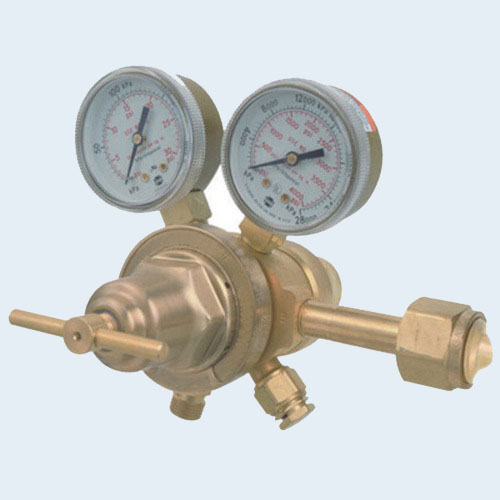 | Heavy Duty Gas Regulator A Heavy Duty Gas Regulator is designed to precisely control high-pressure gases and ensure a stable outlet pressure for industrial applications. View product → |
Frequently asked questions
When is a single-stage regulator the right choice?
Use a single-stage regulator for a stable plant header or point-of-use outlet where moderate outlet-pressure variation will not disrupt the process. Choose two-stage regulation when inlet pressure changes would cause unacceptable outlet variation.
Which figures must you specify when ordering a regulator?
Provide maximum and minimum inlet pressure, required outlet-pressure range, normal and peak flow, allowable pressure droop, inlet and outlet connection sizes, gas temperature, ambient temperature and the required shutoff performance.
How do you match a regulator to the gas and wetted materials?
Identify the gas, concentration, purity, moisture and contaminants, then confirm compatibility for the body, diaphragm, valve seat, seals and fittings. Oxygen service requires components and cleaning practices specified for oxygen use.
How should you size and install a regulator for real gas demand?
Size for minimum inlet pressure and peak flow rather than average consumption. Install the regulator in the correct flow direction, support connected tubing, prevent contamination and verify outlet pressure under flowing conditions.
What should you demand from a single-stage regulator manufacturer before purchase?
Request a datasheet showing pressure and flow limits, materials, connection details, temperature range, gas-service restrictions, performance data, test records, traceability information and installation and maintenance instructions.